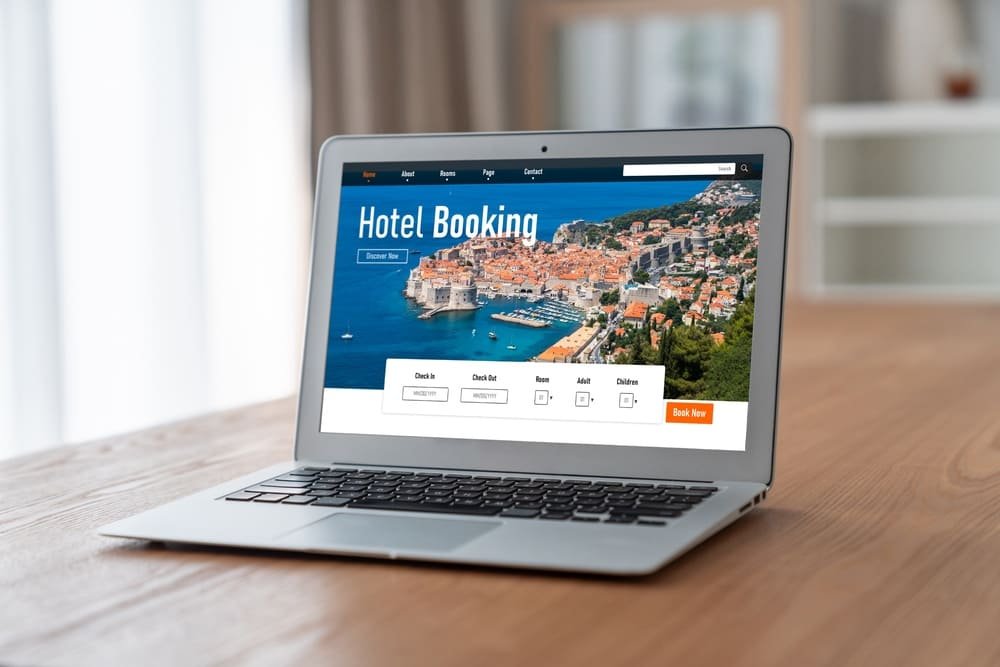
Ask a hotel owner what the website earns and you’ll get a shrug. Ask what OTA commission cost last year and you’ll get an exact figure, usually delivered with a wince. That gap tells you where attention goes. So let’s close it with a pencil and the back of an envelope, and see what an ai chatbot for hotels could add to the page.
The model, in four lines
Take a 60-room independent hotel. The website draws 6,000 visits a month. That’s ordinary, not impressive. Now say 1 per cent of those visitors raise a hand: a room question, a wedding query, a table for a family lunch. That’s 60 enquiries.
If your team answers quickly and well, perhaps a third turn into business. That’s 20 bookings a month. Every figure here is illustrative, so swap in your own. The shape of the sum matters more than the numbers.
Now price it. Say an average booking is worth £300 across a two-night stay. Through an OTA at 20 per cent, each one costs you £60. Twenty bookings carry £1,200 in commission a month, or £14,400 a year. That’s before a single wedding, banquet or dinner enters the picture.
Where the sum quietly breaks
Most hotels don’t reach that 1 per cent. They get nowhere near it. The reason is rarely the website’s looks. It’s timing.
Think about when people plan trips and parties. Evenings. Sunday nights. The commute home. Your front desk has gone quiet and your sales inbox is closed. The visitor types a question into a contact form, hears nothing, and opens an OTA tab. You paid to earn that visit, and a third party collects the fee.
I’ve watched GMs scroll through a Monday inbox and go silent. Eleven weekend enquiries. Nine already stale. Nobody was careless. The hotel simply wasn’t awake when the guests were.
Three levers, and the one most budgets ignore
Your 20 bookings depend on three things: how many people visit, how many raise a hand, and how many you close. Most budgets pour money into the first. It’s the loudest lever and the most expensive.
The other two cost far less to move. Lift the enquiry rate from 1 per cent to 1.5 per cent and 6,000 visits give you 90 enquiries, not 60. Hold the close rate at a third and you’re at 30 bookings. Same traffic. Same ad spend. Half as much again in the diary.
This is where an ai chatbot for hotels earns its place. It answers at 11.00 pm in the property’s own voice, so the visitor never reaches for the OTA tab. It asks what they’re planning, captures a name and number, and passes a warm enquiry to your team with the context attached. That’s hotel lead capture doing what a contact form never could.
It also pitches beyond the room. A guest asking about a Friday arrival hears about the terrace dinner. A couple asking about dates hears about the wedding lawn. A hotel ai agent built for hospitality sells the whole revenue mix, which is where RevPAR improvement actually comes from.
Run your own numbers this week
You don’t need a consultant for this. You need an hour and honest records.
Start with the records you already hold. Pull the last 90 days of website visits from your analytics. Count every enquiry, whether it came by form, email, phone or WhatsApp. Count how many closed. Multiply by your average booking value, then by your OTA rate. Last, count the enquiries that arrived after 7pm and ask how many got a reply that night.
That final count usually stings. It also tells you where to start. If most of your unanswered demand lands out of hours, you don’t have a traffic problem. You have a coverage problem.
What the maths won’t promise
Be careful here. An ai chatbot for hotels can’t rescue uncompetitive rates, and it won’t fix a team that sits on a hot lead for two days. The hand-off still matters. Treat the tool as the front door, and your people as the ones who close.
But the logic holds, and it fits any direct booking strategy worth the name. Capture more intent at the moment it appears, answer it faster than the OTA can, and you’ll increase direct bookings without buying a single extra click. Over a year that’s how you reduce OTA commission, and how OTA dependency reduction stops being a slide in a deck and starts showing up in the P&L.
Twenty bookings a month isn’t a promise. It’s a test you can run on your own figures before you spend anything. If the numbers don’t stack up, you’ve lost an hour. If they do, you’ve found the cheapest revenue in your 2027 budget.
Want to see where your direct enquiries slip away? Book a 20-minute demo with Got AI Hospitality. We’ll run the numbers on your own property, show you how our AI agent captures out-of-hours enquiries on your website, and leave you with a clear view of what it could add to your direct bookings. No obligation, just a sharper sum.
Your website should be your best salesperson.
Let’s show you what it looks like when it is.
No commitment. We’ll show you a live demo on a real hotel.